JillLebofsky may earn a commission if you buy through links on this page, at no extra cost to you. That does not change what we report.
Part of our PureLumin Essence overview. Last checked November 6, 2026.
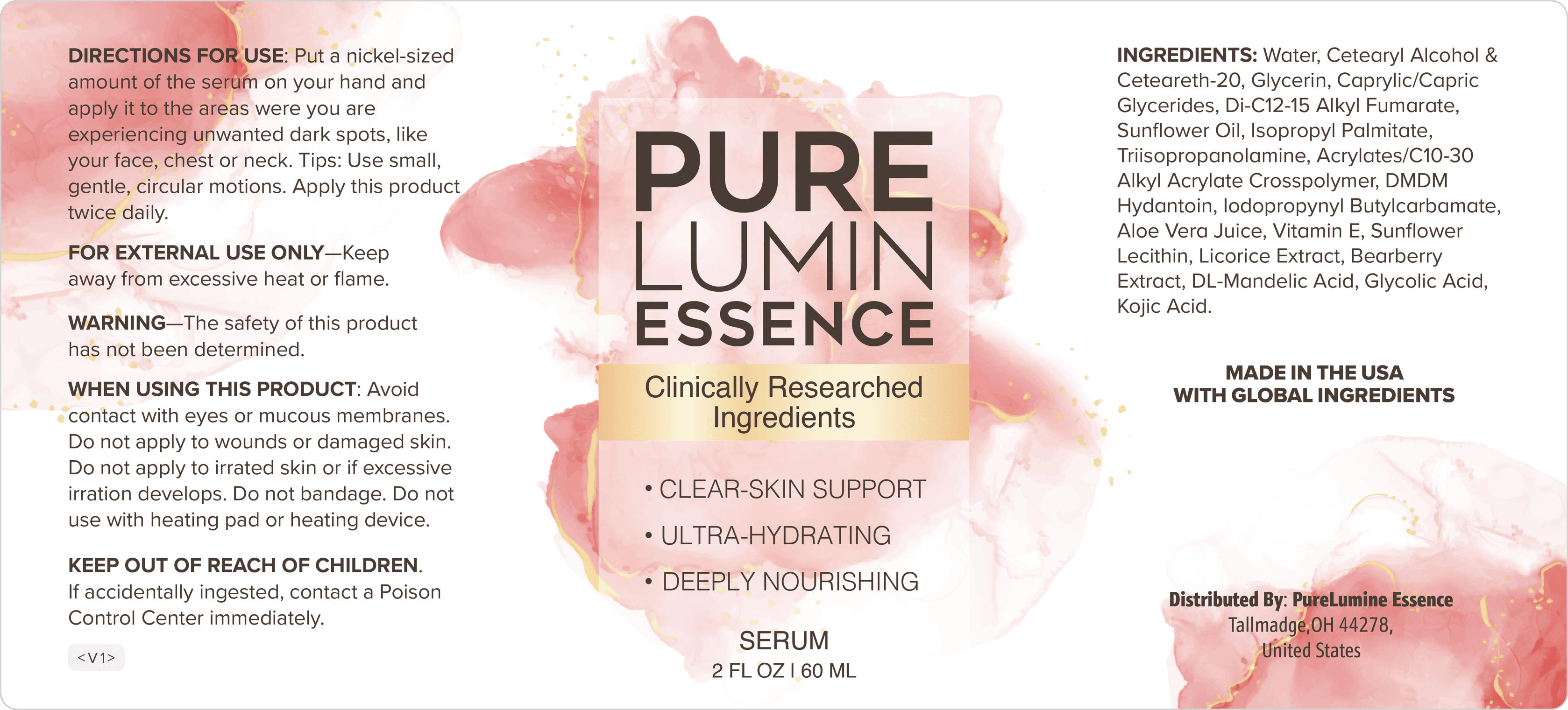
Does pure lumin essence work? We could not find a single published study of PureLumin Essence itself, so whether this 2 fl oz serum fades dark spots is unknown. Its label lists five brightening actives last, after two preservatives, with no percentage for any of them.[2]
The ingredients do have some history. In a 40-patient split-face study, adding 2% kojic acid to a glycolic acid and hydroquinone gel cleared more than half the melasma in 60% of patients, against 47.5% without it.[4]
Does Pure Lumin Essence work? The short answer
The short answer is that nobody can say, because the product has never been tested and its strengths are not printed. What can be said is narrower: kojic acid, glycolic acid, mandelic acid and licorice extract show up in small dark-spot studies, usually as part of a stronger combination.
The label lists Licorice Extract, Bearberry Extract, DL-Mandelic Acid, Glycolic Acid and Kojic Acid at the very end, after DMDM hydantoin and iodopropynyl butylcarbamate.[2] That placement does not prove the amounts are too low, but with no percentages printed there is no way to check them against the studies.
The vendor says the serum "eliminates dark spots".[1] That is a claim about this bottle, and no data on this bottle exists.
Which evidence levels should you not confuse?
Four levels of evidence get blurred together on sales pages. Only the bottom two would tell you whether PureLumin Essence works, and neither exists for it.
Plausibility
Kojic acid, glycolic acid, mandelic acid, licorice and bearberry are known cosmetic brightening ingredients. Lab and animal work on glabridin, a licorice compound, shows it can lower pigment signals in cells.[8] Plausible is the weakest level: it explains why a company might pick an ingredient, not whether a jar of it helps you.
Ingredient trials
Human studies exist, but they test peels at 35% glycolic acid or 45% mandelic acid in a clinic, or 2% kojic acid inside a 10% glycolic gel.[3][6] These results describe those products.
Finished-product trial
A trial of PureLumin Essence against a plain lotion would answer the question directly. We found none, and the vendor's references page cites tranexamic acid, aloesin, niacinamide and vitamin C studies for ingredients that are not on the label.[9]
Replication
Even the ingredient studies are small, mostly 20 to 40 people, and few have been repeated with a placebo arm.
PureLumin Essence claims vs what the evidence supports
Most of the vendor's statements go further than any study we read. The table sets each one against what the sources support.
| Vendor claim | Reasonable reading | Limitation |
|---|---|---|
| "It eliminates dark spots" (sales page) | Some of its ingredients lightened melasma in combination studies | No trial of this serum; strengths not printed |
| Dark spots come from "leaky skin" (contact FAQ) | None of the studies we read use this term | Studies describe melasma and post-inflammatory hyperpigmentation instead |
| "Clinically Researched Ingredients" (label) | Kojic, glycolic and mandelic acid have small human studies | Those used 35% to 45% peels or a 2% kojic gel |
| "Optimally dosed proprietary blend of exotic herbs" (sales page) | Licorice and bearberry are plant extracts | No dose is printed; three of five actives are acids |
| Studies on the references page | Tranexamic acid, aloesin, niacinamide and vitamin C have research | None of those four is in the bottle |
The full ingredient list is printed, which is more than many sellers give. You can read the complete label and directions on our PureLumin Essence serum label guide.
Which ingredients matter most?
Kojic acid and glycolic acid have the most relevant human data, and both were tested at strengths this label does not confirm. Every study below differs from the serum in dose, form or the people tested.
- Kojic acid: in 39 patients, glycolic plus kojic acid matched glycolic plus hydroquinone; 51% responded equally on both sides of the face.[3] It was only ever tested in combinations, and reviews still rank hydroquinone and triple-combination creams first.[5]
- Glycolic acid: a 35% glycolic peel lowered the melasma index (MASI) in a 30-patient trial, with the fewest side effects of the arms tested.[6] That is an in-office peel every 15 days, not a twice-daily lotion.
- Mandelic acid: a 45% peel matched a 30% salicylic peel for mild to moderate acne.[11] Acne, not age spots, was the outcome.
- Licorice: one 20-woman study of liquiritin cream for melasma; the abstract gives no numbers.[7] Reviews say licorice "may be helpful" for spots left after inflammation.[8]
- Bearberry: our evidence covers only swallowed uva ursi for urinary infections, so we found nothing on bearberry cream for spots.
What results are realistic to expect?
Realistic expectations come from the trials, and those ran from 4 weeks to about 3 months with stronger products than a store lotion. The licorice cream study ran 4 weeks with sun avoidance or sunscreen.[7] The glycolic peel trials used about 4 sessions, 15 days apart, which is roughly 2 months.[6]
In the kojic acid study, redness, stinging and peeling settled by week 3.[4] Expect some of that adjustment period first.
The vendor asks buyers to use the serum for at least 3 months, while its refund window is 60 days from delivery.[10] Take photos in the same light at the start and at week 6 so you can decide inside the window. Our PureLumin Essence price and refund page covers the return steps.
When should you see a doctor instead?
See a dermatologist before trying any spot serum if a mark is new, changing or patchy across both cheeks, since melasma and changing spots need a diagnosis. The licorice, kojic and glycolic studies all enrolled patients diagnosed by doctors.
See a doctor right away if:
- a spot changes size, shape or color, or has uneven borders
- a spot bleeds, crusts, itches or does not heal within a few weeks
- a new dark spot appears and grows quickly
- the serum causes blisters, burns or swelling of the face, lips or eyes
- you have trouble breathing after applying any product
Our PureLumin Essence side effects guide lists the reactions the acids can cause.
Evidence conclusion
PureLumin Essence contains ingredients with limited evidence and gives you no way to check how much of each is in the bottle. That leaves its results unproven.
| Decision question | Current assessment (checked November 6, 2026) |
|---|---|
| Has the serum itself been tested? | No published trial found |
| Are the actives known brighteners? | Yes, with limited human evidence |
| Are the strengths disclosed? | No percentage for any active |
| Is sun protection needed? | Yes, glycolic and mandelic acid are AHAs |
| Can you get a refund? | 60 days from delivery, return postage paid by you |
If you try it, use daily sunscreen and judge it by photos, not by the sales page. The method behind our checks is on how we check products.
Back to the PureLumin Essence overview.
Frequently asked questions
Is there a clinical trial on PureLumin Essence?
We found no published trial of PureLumin Essence itself, checked November 6, 2026. The evidence the vendor leans on comes from studies of single ingredients such as kojic and glycolic acid, often tested as in-office peels or at strengths the serum label does not print.
How long does PureLumin Essence take to fade dark spots?
There is no product data. Ingredient studies ran 4 weeks to about 3 months, and the vendor asks for 3 months of use. Its refund window is 60 days from delivery, so compare dated photos around week 6 before deciding.
Does kojic acid fade dark spots?
Kojic acid has limited evidence. In split-face melasma studies it worked about as well as hydroquinone when both were mixed with glycolic acid, and adding 2% kojic acid raised the share of good responders from 47.5% to 60%. It was more irritating.
Can PureLumin Essence help melasma?
Unknown. Melasma studies used 35% glycolic peels, 2% kojic acid gels or liquiritin cream under a doctor. PureLumin Essence prints no strengths. Melasma needs a dermatologist diagnosis and strict daily sunscreen whatever cream you use.
Is PureLumin Essence stronger than hydroquinone?
No study compares them. Published overviews still rank hydroquinone and triple-combination creams as the standard for melasma. Kojic acid matched hydroquinone only inside glycolic acid mixtures, and the serum does not say how much kojic acid it holds.
Sources
- PureLumin Essence sales page. PureLumin Essence (BuyGoods), read November 6, 2026.
- PureLumin Essence product label image. PureLumin Essence, read November 6, 2026.
- Garcia 1996, glycolic acid with kojic acid vs hydroquinone for melasma. PubMed, read November 6, 2026.
- Lim 1999, 2% kojic acid added to glycolic acid and hydroquinone gel for melasma. PubMed, read November 6, 2026.
- Gonzalez-Molina 2022, melasma options review. PubMed, read November 6, 2026.
- Garg 2019, 35% glycolic acid peel alone or with TCA for melasma. PubMed, read November 6, 2026.
- Amer 2000, topical liquiritin for melasma. PubMed, read November 6, 2026.
- Davis 2010, post-inflammatory hyperpigmentation review. PubMed, read November 6, 2026.
- PureLumin Essence references page. PureLumin Essence, read November 6, 2026.
- PureLumin Essence refund policy. PureLumin Essence, read November 6, 2026.
- Dayal 2020, 45% mandelic acid vs 30% salicylic acid peels for acne. PubMed, read November 6, 2026.
This page is general information, not medical advice. Dietary supplements are not reviewed by the FDA for safety or effectiveness before they are sold and are not intended to diagnose, treat, cure or prevent any disease. Talk to your doctor before taking any supplement, especially if you are pregnant, nursing, take medication or have a health condition.